
Guns / American Icons · November 20, 2026 · RMCC 0259
The 1860 Henry Rifle: The 16-Shot Lever Action That Became the Winchester
Patented in 1860 and built by Oliver Winchester's New Haven Arms Company, the 16-shot Henry rifle outgunned single-shot muzzleloaders in the Civil War and became the Winchester Model 1866.
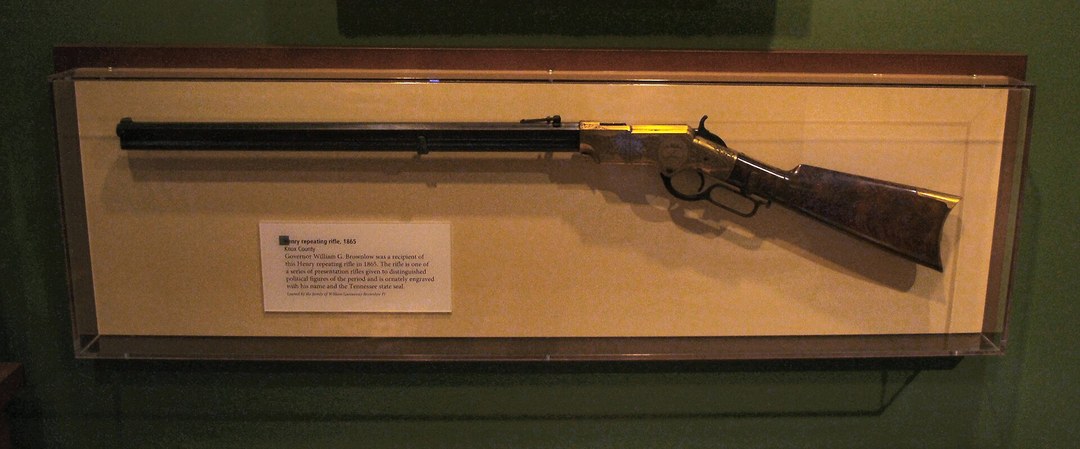
Before there was a Winchester, there was a Henry.
In 1860, Benjamin Tyler Henry, a gunsmith working for Oliver Winchester's New Haven Arms Company, patented a lever-action rifle after about three years of work. It fired a .44 rimfire cartridge and held 16 rounds: 15 in a tube under the barrel and one in the chamber.
In a war fought mostly with single-shot muzzleloaders, that changed the math. Work the lever, pull the trigger, repeat.
The government bought only 1,731 of them, but more than 10,000 Henrys saw service in the Civil War, many bought by soldiers with their own money. Confederate Col. John Mosby gets credit for the line that stuck: "that damned Yankee rifle that can be loaded on Sunday and fired all week."
It wasn't perfect. The exposed magazine tube could pick up dirt and got hot with heavy shooting, and the rifle couldn't take a bayonet.
About 14,000 were built from 1860 to 1866. Then the design was improved into the Winchester Model 1866, and New Haven Arms became the Winchester Repeating Arms Company. The 1873 and the Model 94 we've covered here both trace back to this rifle.
Some Henrys were presentation pieces. President Lincoln was given an engraved, gold-plated Henry, serial No. 6, now at the Smithsonian. The one pictured here was given to Tennessee Gov. William "Parson" Brownlow in 1865.
Original Henrys have brought $50,000 to $250,000 at auction.
Sources & image credits
- Wikipedia: Henry rifle (patent 1860; .44 rimfire; 1860-1866 production, ~14,000; 1,731 government purchases; >10,000 in Civil War service; magazine drawbacks; Winchester Model 1866)
- NRA Family: Henry Rifles: An American Classic (Benjamin Tyler Henry hired by Oliver Winchester; 16 rimfire cartridges; Mosby quote; Lincoln's gold-plated serial No. 6 at the Smithsonian; originals $50,000-$250,000)
- Library of Congress research guide: Winchester (New Haven Arms Company to Winchester Repeating Arms)
- Wikimedia Commons file description (Brownlow presentation Henry, 1865, East Tennessee History Center)
- Smithsonian National Museum of American History: Henry rifle (about 14,000 made 1860-1866; only about 1,731 purchased by the Ordnance Department between 1862 and 1865; many privately purchased)
- American Society of Arms Collectors, John D. Rausch, 2016 (U.S. government sales limited to 1,731 rifles; issued mainly to the 1st D.C. Cavalry and later the 3rd Regiment, U.S. Veterans Volunteer Infantry)

Image attribution, source, license and modifications are shown in the caption above.
Facts checked November 20, 2026 at 1:17 PM MST.