
Guns: American Classics · Red Meat & Cigar Club editorial
Iconic American Firearms
The Colt Single Action Army, Winchester 1873, M1911, and M1 Garand.
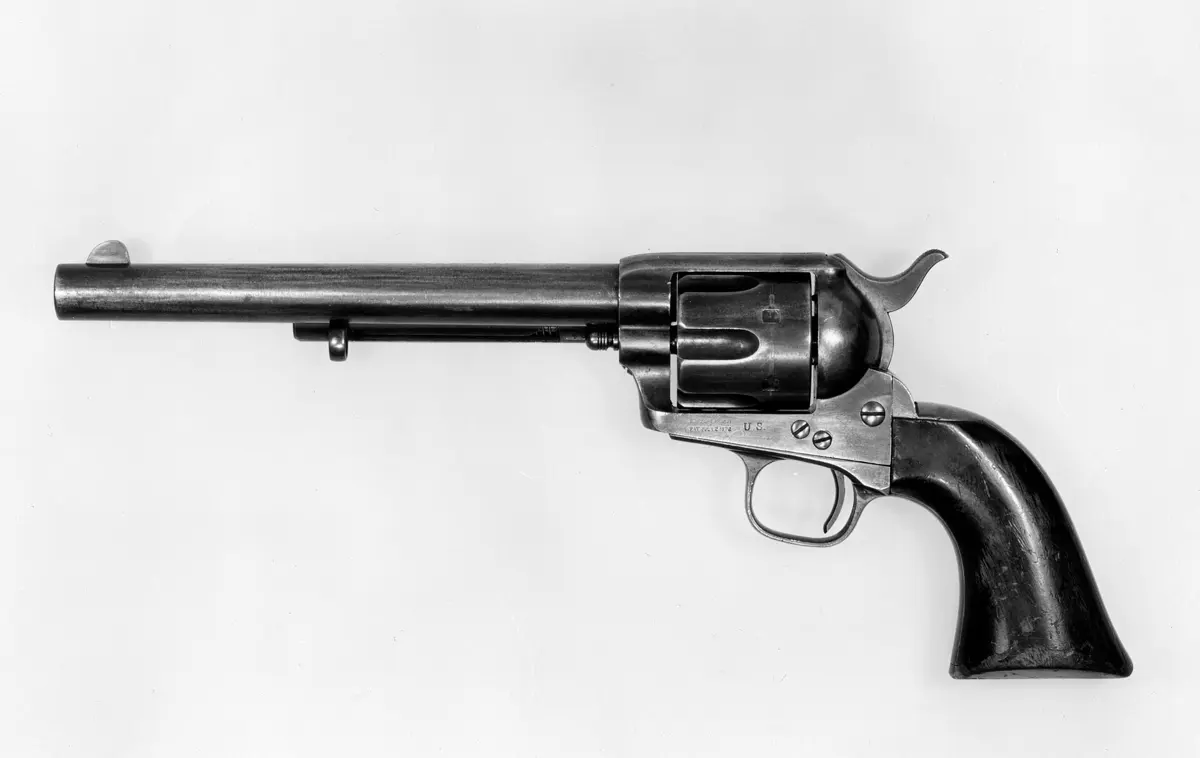
Few objects are as tied up with American history as a handful of firearms. They show up in museum cases, in old photographs, in Westerns, and in family stories handed down with the gun itself. This is a look at four of the most famous — the Colt Single Action Army, the Winchester Model 1873, the M1911 pistol, and the M1 Garand — as history and as design, not as a shopping list.
Colt Single Action Army (1873)
Colt's Patent Fire Arms Manufacturing Company introduced the Single Action Army in 1873, and the U.S. Army adopted it the same year as its standard service revolver. The original military chambering was the .45 Colt cartridge. "Single action" means the hammer has to be cocked by hand before each shot; the six-shot cylinder is loaded one chamber at a time through a gate on the right side of the frame.
Civilians quickly gave it nicknames — "Peacemaker" is the best known — and it became the revolver most associated with the American frontier. Colt stopped making it in the early 1940s, when factories turned to wartime production. Demand driven partly by television and film Westerns brought it back in the 1950s, and versions are still made today. It has been in and out of production for more than 150 years.
Winchester Model 1873
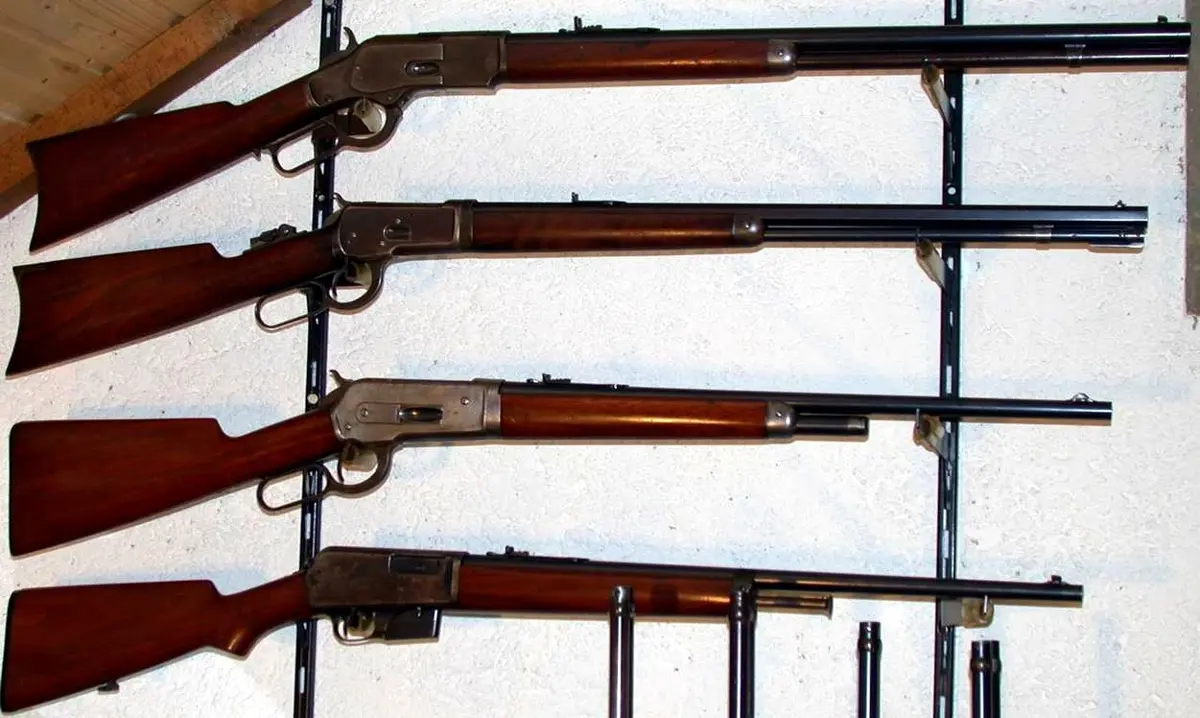
The Winchester Model 1873 came out of a line that started with the 1860 Henry rifle and the Winchester Model 1866. The 1873 had a stronger iron (later steel) frame and was chambered for centerfire cartridges, most famously the .44-40 (.44 WCF). That cartridge could also be fired in revolvers chambered for it, so a rider could carry one kind of ammunition for both guns.
Winchester advertised the rifle as "The Gun That Won the West," and the slogan stuck. Production ran from 1873 until 1919 or so, with more than 700,000 made. The lever action — work the lever down and back up to eject the spent case and chamber a new round from the tube magazine under the barrel — is still one of the most recognizable mechanisms in the world.
The M1911 pistol
John Moses Browning, the most influential firearms designer of his era, designed the pistol that the U.S. Army adopted in 1911 as the M1911. It fires the .45 ACP cartridge from a detachable seven-round magazine in the grip, and it uses Browning's short-recoil operating system, which went on to become the basis for many later pistols.
A revised version, the M1911A1, came along in the 1920s with small changes to the grip safety, trigger and mainspring housing. In one form or another the 1911 was the standard U.S. military sidearm through both World Wars, Korea and Vietnam, until the Beretta M9 was chosen in 1985. Many companies still build 1911-pattern pistols, and the design has a huge following in competition shooting.
M1 Garand
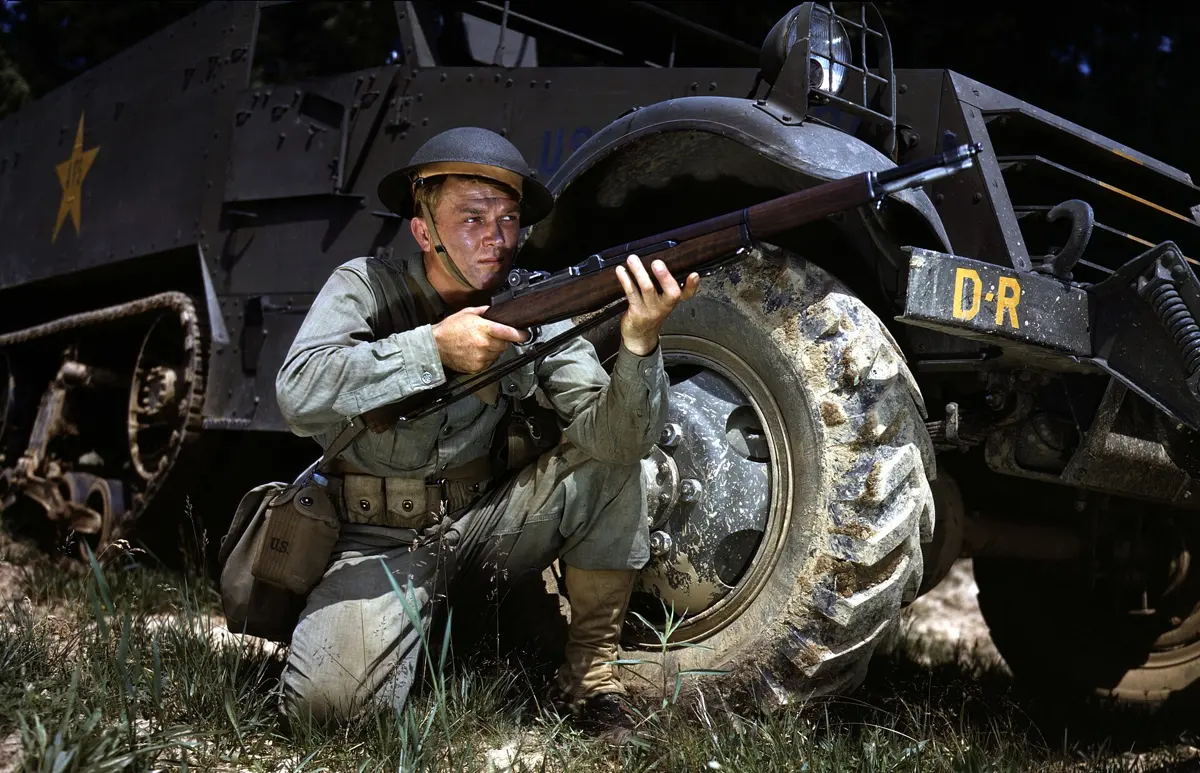
John C. Garand, a Canadian-born engineer working at the government's Springfield Armory, designed the semi-automatic rifle the Army standardized in 1936 as the M1. Chambered in .30-06 Springfield, it loads from an eight-round en-bloc clip; when the last round is fired, the clip ejects with a distinctive "ping" that veterans still talk about.
The United States was the first nation to field a semi-automatic rifle as its standard infantry arm, which gave American soldiers in World War II a big advantage in firepower over bolt-action rifles. General George S. Patton is widely quoted as calling it "the greatest battle implement ever devised." The M1 served through the Korean War before the M14 replaced it.
Why these four still matter
Each of these guns marks a turning point: the cartridge revolver in the West, the repeating lever-action rifle, the self-loading pistol, and the semi-automatic infantry rifle. They're studied by collectors and historians, shown in museums such as the Metropolitan Museum of Art and the Smithsonian, and still fired by people who enjoy historical arms at the range. If you own or inherit one, learn its history, follow every applicable law, and store it safely. Some of these are valuable antiques, and you should have a qualified gunsmith check one before you shoot it.
Affiliate disclosure: Red Meat & Cigar Club may earn a commission from some links on this site at no extra cost to you. Learn more.