
Betting 101 · Red Meat & Cigar Club editorial
Parlays
Bigger payout, much harder to hit.
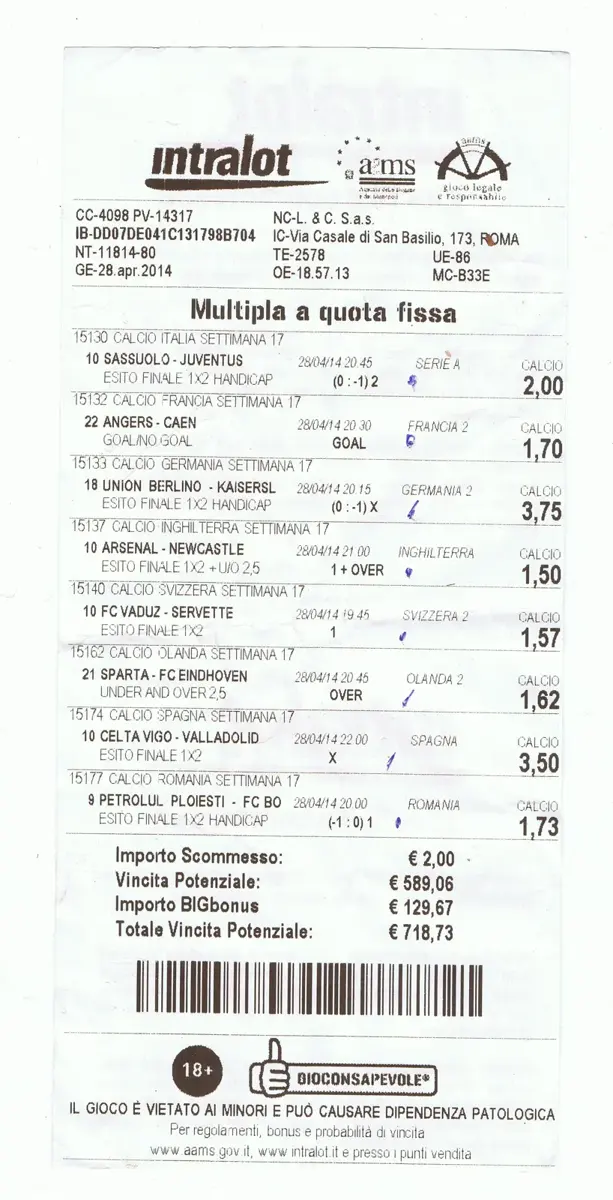
Example numbers — made up for illustration, not real lines
Parlays are the lottery tickets of sports betting: string several bets together, and if every one of them wins, the payout multiplies. They're enormously popular, they make for great stories when they hit — and they're mathematically some of the hardest bets to win.
How a parlay works
Each individual bet in a parlay is a "leg." All legs must win for the parlay to pay. If any leg loses, the whole ticket loses. Example: three legs, each priced at -110 (decimal 1.91). Multiply them: 1.91 × 1.91 × 1.91 ≈ 6.97. A $10 parlay returns about $69.70 — roughly +597 in American odds.
The probability problem
Suppose each of those three legs were a true 50/50. The chance of all three winning is 0.5 × 0.5 × 0.5 = 12.5%, or one in eight. Fair odds for a one-in-eight shot would be +700 (8.00 decimal). The parlay pays about +597. That gap is the book's margin, compounded on every leg. Add more legs and the gap usually widens:
| Legs (each 50/50) | Chance all win | Fair payout | Typical -110 parlay payout |
|---|---|---|---|
| 2 | 25% | +300 | about +264 |
| 3 | 12.5% | +700 | about +596 |
| 4 | 6.25% | +1500 | about +1228 |
| 6 | 1.56% | +6300 | about +4741 |
These are illustrative calculations, not any book's actual parlay table. Some books use fixed parlay payout tables that differ from true multiplied odds.
Same-game parlays
Same-game parlays (SGPs) combine bets from a single game — for example, a team to win, a quarterback over a yardage number, and the game total over. Because those outcomes are often correlated, books price SGPs with their own models rather than simply multiplying the odds. Industry reporting and sportsbook financial results have consistently shown that parlays and SGPs carry higher hold percentages for operators than straight bets. In plain English: they're more profitable for the house.
Pushes and voids
If one leg pushes (lands exactly on the spread or total) or is voided (a player doesn't play, a game is postponed), most books drop that leg and recalculate the parlay with the remaining legs. Rules vary, so read your book's house rules.
Parlay "insurance" and boosts
Books often promote parlays with odds boosts or refunds if one leg misses. These promotions can improve the price slightly, but they're designed to encourage more parlay betting. Read the terms carefully, including whether a refund comes back as cash or as site credit with conditions.
Why people love them anyway
A small stake for a shot at a big return is genuinely fun, and a parlay gives you a reason to care about several games at once. There's nothing wrong with that as entertainment, so long as you treat the stake as the cost of a long-shot thrill.
Smart habits
- Keep parlay stakes small — think of them as a fraction of your normal unit.
- Fewer legs means better odds of hitting.
- Don't add legs just to make the payout bigger.
- Never chase a busted parlay with a bigger one.
Parlays are where the dream lives and where the house earns. Enjoy them knowingly.
Worked example: why one leg kills the ticket
Example: a four-leg parlay hits three legs and loses the fourth by half a point. The payout is zero. Placing those same four bets as separate straight bets would have returned three winners and one loser, roughly a small profit at -110. The parlay turns "mostly right" into "completely wrong," which is the trade-off for the bigger payout.